Your next course, designed by 11 AI agents.
It's not another lesson generator: it's a full instructional design team. It analyzes, structures, writes, builds interactions, scripts and assessments, checks accessibility and scores the quality. From a short training course to a full semester-long course: you approve, and it ships ready for your campus or as SCORM, syllabus included.
Example brief: Warehouse safety for operators and shift supervisors, built on real cases from the logistics industry.
- 11
- specialized agents
- 11
- instructional models
- 8
- interaction types
- 3
- formats: SCORM 1.2, 2004 and xAPI
- 0–100
- QualityScore before you publish
What comes out of the Forge
A complete course, layer by layer. Not a draft.
A generator hands you modules and questions. The Forge delivers the eight layers an instructional design team would take weeks to produce, each one signed by the agent that made it.
01 / 08 · Learning analyst
Objectives
Measurable objectives with Bloom levels, a profile of your audience and the learning risks to plan for.
Live example
Watch a workplace safety course take shape.
A training provider's brief, 11 agents in sequence, and two moments where the Forge stops and waits for you. When it's your turn, you approve. Then play the scenario and the quiz: that's exactly what students get.
INPUT BRIEF
A risk prevention course for warehouses and distribution centers. By the end, participants can spot the most common hazards in load handling, use personal protective equipment correctly and follow the company's incident reporting procedure. It includes real cases from the logistics industry and a final hands-on assessment.
AUDIENCE
Warehouse operators and shift supervisors, with or without prior safety training.
AI Forge · Safe warehouse: risk prevention in distribution centers
Ready to design0/11AGENT 01 OF 11
Learning analyst
Learning objectives with Bloom level, audience profile and risks
The run starts as soon as this window is on screen.
Illustrative example, sped up: this is what a Forge run looks like and what each agent delivers. In the product, every stage is saved and editable, with its full history.
The team
11 specialists. One director: you.
Each agent does one job and does it with method. Choose how much control you want and see which stages go through your hands.
You review the stages that shape quality most; the rest approve themselves. You review 6 of 11 stages.
- 01You review
Learning analyst
Learning objectives with Bloom level, audience profile and risks.
Do the objectives describe what you really want your students to achieve?
- 02You review
Instructional designer
Full structure: units, lessons, types and duration.
Do the sequence and number of units fit your time and your audience?
- 03Auto-approved
Microlearning architect
Chunking, spaced repetition and anchor lessons.
Are the lessons split into digestible blocks for your format?
- 04You review
Content writer
Full text of every lesson, key ideas, glossary and retrieval questions.
Is the content accurate, with the tone and depth you expect?
- 05You review
Interaction designer
Branching scenarios, sorting, flashcards, processes and checks inside each lesson.
Do the interactions practice what the lesson teaches, with believable consequences?
- 06Auto-approved
Scriptwriter
Video scripts with timed scenes (teleprompter).
Would you feel comfortable recording this script as is?
- 07Auto-approved
Graphic designer
Slide outline for each video, with alt text.
Do the slides support the script without overloading it with text?
- 08You review
Activity designer
Quizzes with questions and feedback, assignments with rubrics, discussions.
Do the questions and assignments assess what you taught, and are they fair?
- 09Auto-approved
Assessment advisor
Objective ↔ assessment alignment and a gradebook proposal.
Do the weights reflect what matters most to assess?
- 10Auto-approved
Accessibility and UDL
WCAG 2.1 AA review, captioning plan and alternative formats.
Are there critical findings you must fix before publishing?
- 11You review
Pedagogical QA
QualityScore 0-100 with breakdown and prioritized recommendations.
If the score is below 70, consider regenerating before you materialize.
- 12
You're in charge
Approve, edit or regenerate any stage. The Forge proposes; nothing goes live without your sign-off.
11 instructional models to choose from
Microlearning
5 to 12-minute blocks with spaced review.
ADDIE
Linear, documented design in five phases.
SAM
Fast iterations with prototypes and adjustments.
Backward Design
Starts from outcomes and assessments.
5E
Engage, explore, explain, elaborate and evaluate.
Flipped classroom
Content first, practice in the time together.
Project-based learning
One capstone project as the common thread.
Problem-based
Real problems as the starting point.
Competency-based
Progress through evidence of performance.
Cohort-based
Group pace, discussion and shared deadlines.
Mixed
A pragmatic blend of several models.
Full courses and syllabi
Semester-long courses for universities and colleges, syllabus included.
The Forge goes beyond short courses: it designs semester-long courses of up to 200 hours, with units, classes, assessments, rubrics and a gradebook. It also drafts the syllabus in your institution's format, with versions that never overwrite each other. Your team reviews it, fills in the institutional details and approves it.
Chilean universities: CRUCH format
Measurable learning outcomes, content by unit, methodology, assessment and bibliography, with SCT-Chile credits.
Technical colleges (CFT and IP): MCTP structure
Expected learning outcomes written as performance, evidence-based criteria and a proposed level in Chile's technical qualifications framework (MCTP), with its rationale and descriptors. Your team confirms it and adds the ChileValora codes.
Training providers (OTEC): SENCE Form 1
Target population, competency to develop, outcomes by module and assessment with minimum attendance.
Versions for accreditation
Every change creates a new version that never replaces the previous one, with a print view for the accreditation file.
Programa de módulo
Chilean CFT program (MCTP)
Module program with descriptors and level from Chile’s technical-vocational qualifications framework (MCTP).
- 01Forge + team
Antecedentes generales
General information · program, module, year and semester, type of course activity, delivery mode, SCT credits and hours, prerequisites, code
- 02Forge
Descripción del módulo
Module description · purpose, scope and how it is assessed
- 03Your team
Contribución al perfil de egreso
Contribution to the graduate profile · signature, generic and specific competencies the module contributes to
- 04Forge
Resultados de aprendizaje asociados al MCTP
MCTP-aligned learning outcomes · level with its rationale, descriptors by dimension and subdimension, qualification and competency units
- 05Forge
Aprendizajes esperados
Expected learning outcomes · written as performance
- 06Forge
Competencias a desarrollar
Competencies to develop · by unit: conceptual, procedural and attitudinal knowledge, with assessment criteria
- 07Forge
Estrategias metodológicas
Teaching strategies · workshop, lab, on-site learning
- 08Forge
Procedimientos de evaluación
Assessment procedures · by unit: type of evidence, activity, instrument and weight
- 09Your team
Infraestructura, equipamiento e insumos
Facilities, equipment and supplies · materials, equipment with quantities, and spaces
- 10Your team
Perfil docente
Instructor profile · education and experience of the module instructor
- 11Forge
Recursos para el aprendizaje
Learning resources · regulations, bibliography and verifiable digital resources
The Forge drafts 7 of 11 sections from the course's objectives, structure and assessments and leaves one more in draft for your team to complete with institutional data. Every change saves a new version.
CURRICULUM MAP · LOGISTICS TECHNICIAN · 2026 PLAN
63 creditsStudy plans
The whole curriculum map, in the same place.
Programs, versioned study plans and curriculum maps with credits, theory, practice and self-study hours, and prerequisites between courses. Right next to the syllabi and the courses being taught.
Compare
Generating lessons is not designing a course.
What separates a draft from a course people actually learn from, that assesses fairly and that passes accreditation.
| Capability | TypicalTypical AI course generator | Neurate AI Forge |
|---|---|---|
| Modules, lessons and quizzes from a topic | Included | |
| Export to your LMS | SCORM 1.2, SCORM 2004 and xAPI | |
| Objectives with Bloom levels, aligned to every assessment | Alignment matrix | |
| Instructional model of your choice | 11 models | |
| Branching scenarios and interactive activities | Basic | 8 block types |
| Video scripts with teleprompter and slides | Timed scenes | |
| Real-voice narration, even a cloned voice with consent | Included | |
| Rubric-graded assignments and a weighted gradebook | Included | |
| Syllabus in CRUCH, MCTP or SENCE format (Chile) | Versioned draft | |
| Study plans and curriculum maps with prerequisites | Included | |
| Accessibility review | WCAG 2.1 AA | |
| Pedagogical quality score before publishing | QualityScore 0–100 | |
| Human review at every stage | Basic | 3 levels of control |
| Campus, AI coach, storefront and certificates on one platform | Included | |
| Chilean compliance: SENCE and Ley 21.719 | Built in |
Compared with the features AI course generators on the market usually offer.
Export or publish
Ready for wherever you already teach.
You don't have to switch platforms to use the Forge. And if you do switch, the full campus is already included.
Your Neurate campus
Publish in one click: classroom, 24/7 AI coach, certificates with verifiable QR and your own storefront.
Your current LMS
SCORM 1.2 or SCORM 2004 package with its own player and images included, for Moodle or any compatible LMS.
Your LRS
Export to xAPI and track every interaction, attempt and result in your Learning Record Store.
The platform
And when you publish on Neurate, everything else is already there.
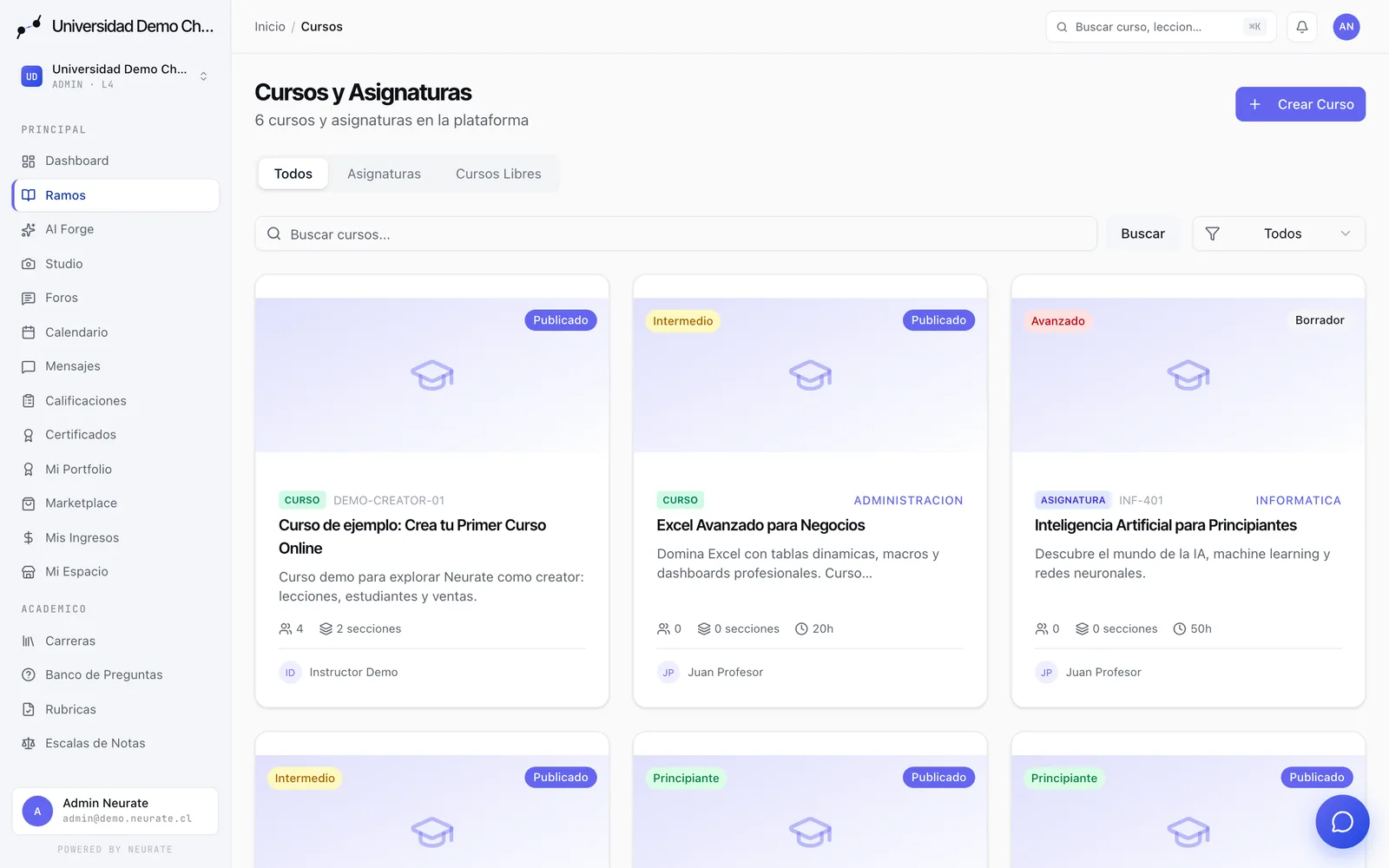
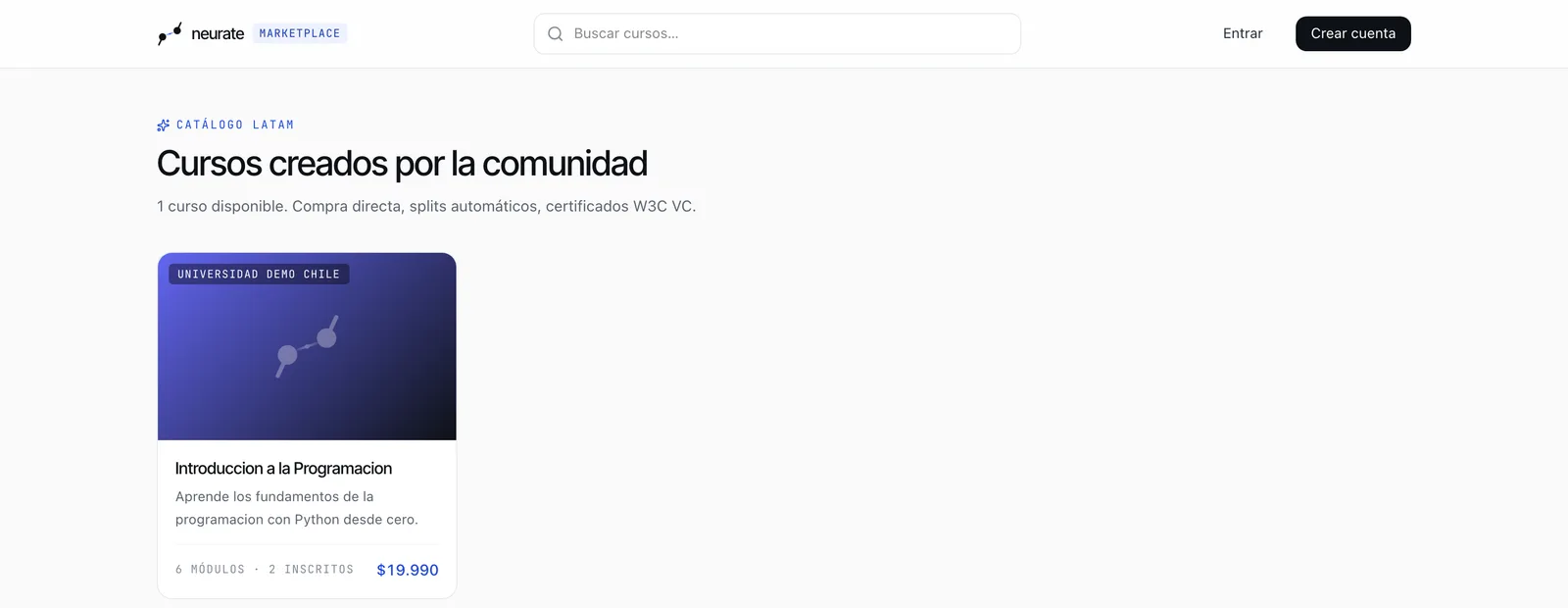
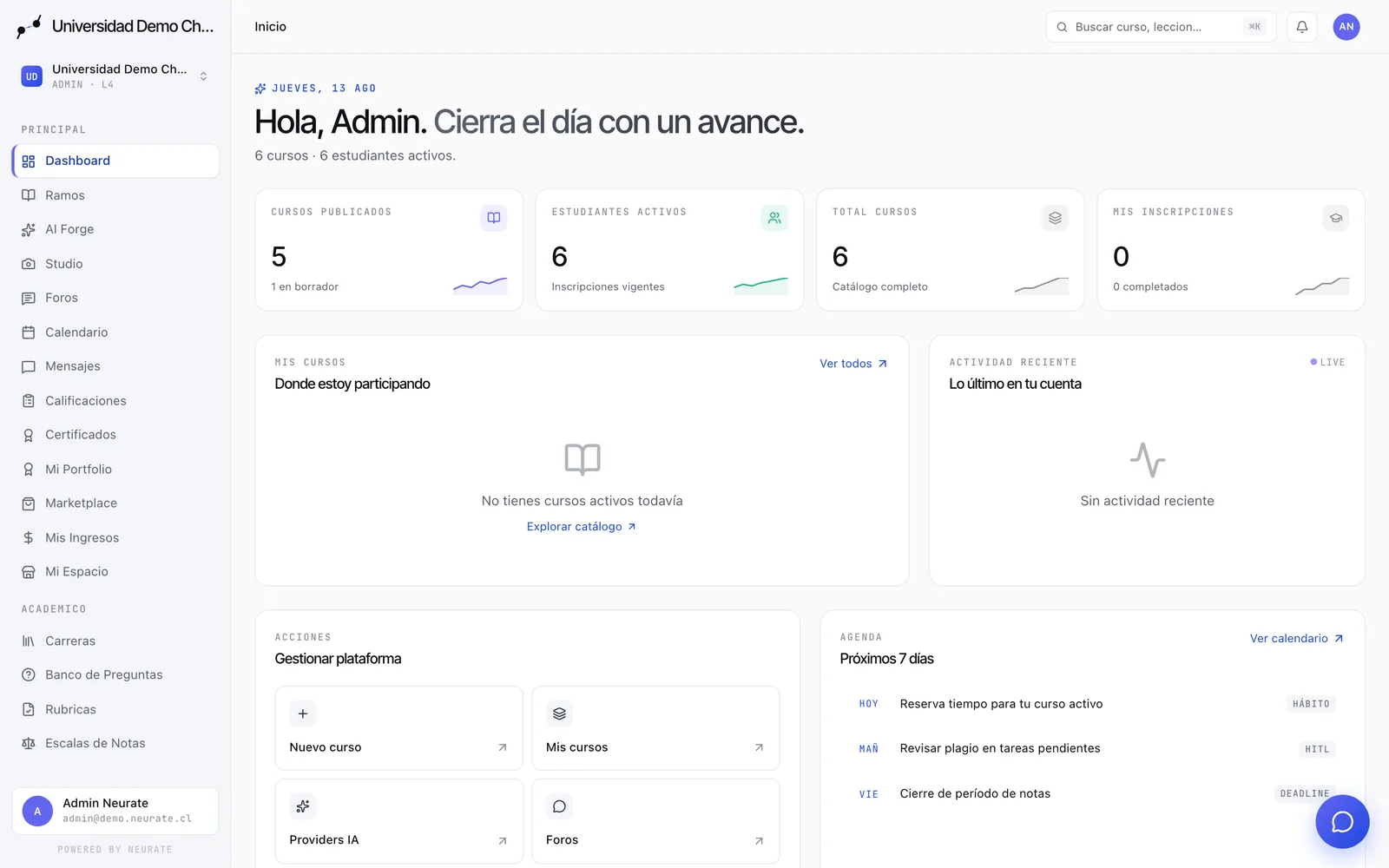
24/7 AI coach
Answers with citations to the course content, by text, voice or image.
Recording Studio
Camera, screen and a teleprompter loaded with the Forge script.
Real voice
Studio-quality narration without recording yourself, with a stock voice or your own.
Storefront and marketplace
Direct sales with Mercado Pago and automatic revenue splits.
Verifiable certificates
With a QR code and a public verification page.
Chilean compliance
SENCE, accreditation mode and Ley 21.719 out of the box.
Who it's for
The same Forge, in your organization's vocabulary.
Universities and technical colleges
Full semester-long courses with their syllabus, curriculum maps with prerequisites, and attendance.
Training providers
Courses with SENCE Form 1 for Chilean providers, practical assessment, rubrics and reports.
Companies
Onboarding, procedures and compliance training your team actually finishes, in your LMS or ours.
Creators
From idea to a course for sale, narrated in your voice, with your own storefront.
Questions
What everyone asks.
How is the AI Forge different from an AI course generator?
A generator hands you a draft: modules, lessons and questions. The Forge works like an instructional design team of 11 specialists: it sets measurable objectives, picks one of 11 pedagogical models, writes every lesson, builds interactions, scripts and slides, aligns every assessment with an objective, checks accessibility and gives you a quality score before you publish.
Does the AI publish anything without my review?
No. You choose the priority for each run: on Fast you review the structure and the final quality; on Balanced, the six stages that matter most; on Deep, every agent's work. You can edit or ask an agent to regenerate its part, and nothing is published without your approval.
Can I use the courses in my current LMS?
Yes. Export your course as SCORM 1.2, SCORM 2004 (4th edition) or xAPI, with its own player and images included, and upload it to Moodle or any compatible LMS. Or publish it directly on your Neurate campus, with AI coach, certificates and storefront.
Does it write in English?
Yes. You choose the course language when you start a run, and every agent writes in it: lessons, interactions, scripts, quizzes, rubrics and feedback. The AI coach answers students in the course language, and the whole interface is available in English and Spanish.
Does real-voice narration replace the instructor?
No. It's an audio alternative for those who don't want to or can't record themselves: the voice can be a stock voice or an instructor's cloned voice with their written consent, and students are always told the narration is synthesized.
What happens to my students' data?
It's never sold or used to train third-party models. The platform is built for Chile's data protection law (Ley 21.719): granular consent, data subject rights with deadlines and strict isolation between institutions.
Can I use it today? How much does it cost?
We're in a closed pilot through 2026, and the pilot is free. Create your account and you're on the list: we'll reach out to activate your space and build your first course with you. Later there will be a free tier for creators and per-student plans for institutions.
Design your first course with us.
Join the 2026 pilot: we activate your space, build your first course with you, and you publish it on your campus or your LMS. No card, no commitment.